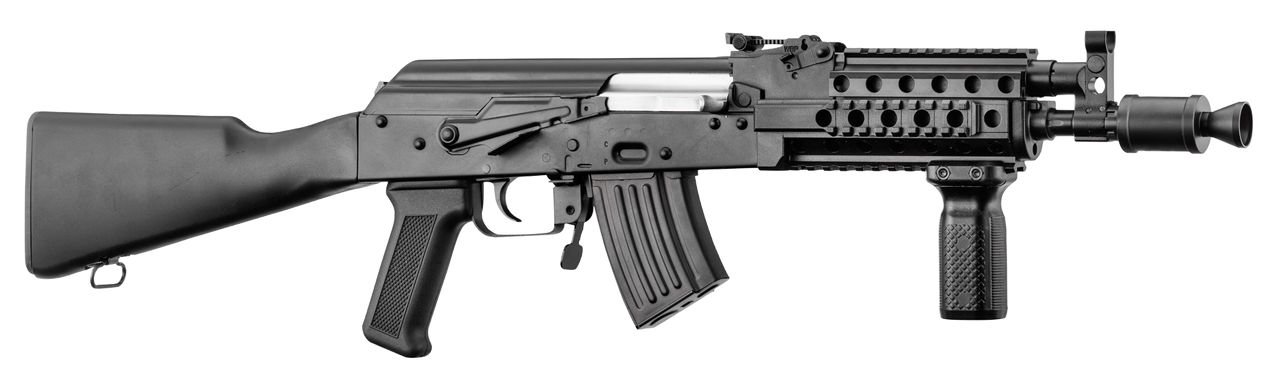
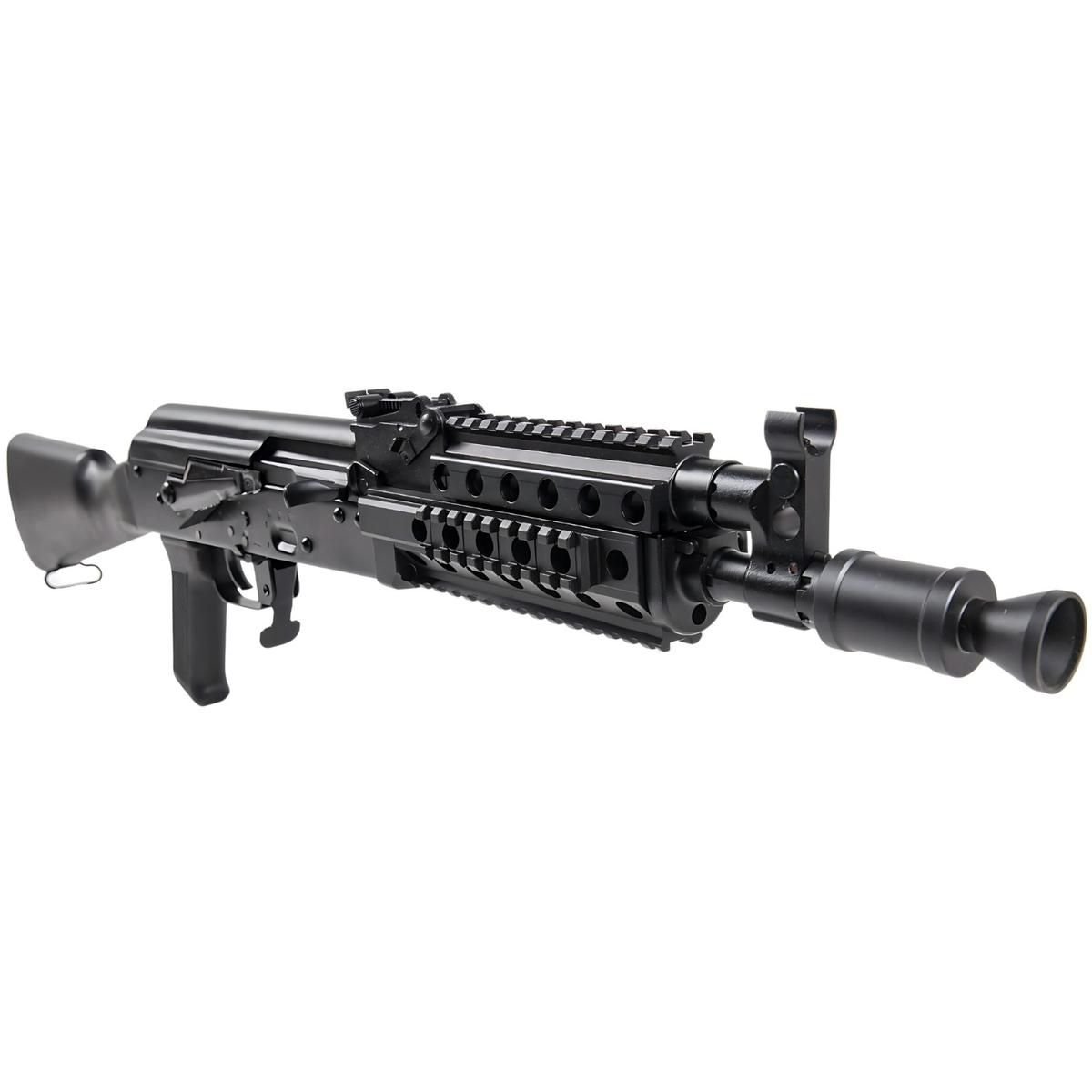
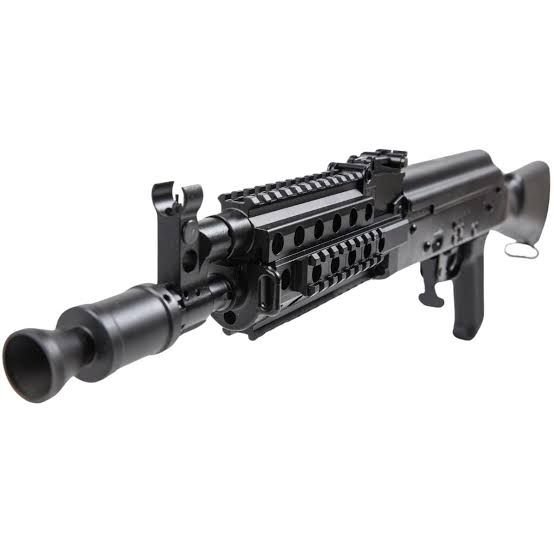
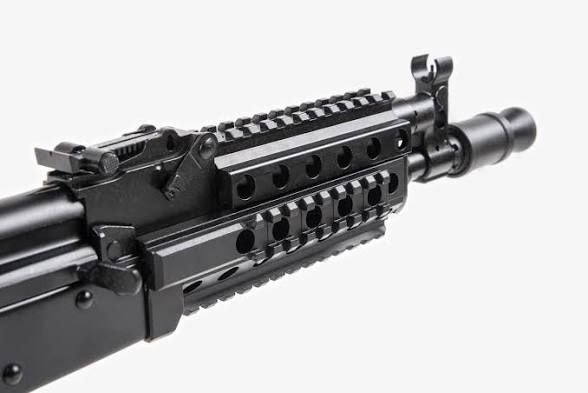

WBP Rogów – Mini Jack Rifle – Tactical – 7,62 x 39 mm
€900.00
Caliber: 7.62×39 mm
Type: semi-automatic
Weight: 2.95 kg
Length: 780 mm
Barrel length: 259 mm
Velocity: 644 m / s
Stock: Fixed
Picatinny handguard
A compact and modern semi-automatic version of the Kalashnikov
- Carcass made of pressed sheet metal
- Fixed stock and polymer grip
- Metal handguard with 21mm Picatinny quad rail system
- Front handle
- Muzzle brake on M14x1LH thread
- Side base for mounting an optic
- 10-round magazine
- Delivered in plastic case
Wytwornia Broni Jacek Popinski (WBP) is an independent manufacturing company based in Rogów, Poland. The manufacturing plant has a fully equipped workshop for the manufacture, maintenance and repair of small arms.
The main activity of the company WBP is the production of assault rifles in cal. 7.62 x 39 mm in semi-automatic mode.
WBP’s know-how enables the design and development of the AK platform.
Description
AK-Pattern Rifles: History, Design Philosophy, and Global Influence
Origins of the AK Platform and Post-War Rifle Development
The story of AK-pattern rifles begins during the mid-twentieth century, a period marked by rapid innovation in military small-arms technology. During the final years of the Second World War and the early years of the Cold War, military planners across the world sought new rifle designs that could provide both reliability and controllable automatic fire. Earlier infantry rifles often fired full-power cartridges that produced strong recoil, which made automatic fire difficult to control wbp rogów mini jack rifle.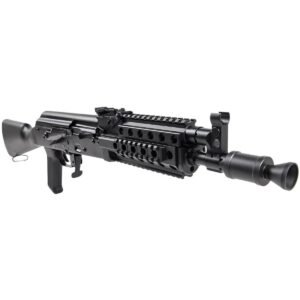
Consequently, engineers began exploring the concept of intermediate cartridges, which produced less recoil while still providing effective range for typical infantry engagements.
This shift in ammunition design required a new generation of rifle platforms capable of balancing power, control, and reliability. In this context, Soviet designers began working on a rifle that could operate effectively with intermediate cartridges while maintaining mechanical simplicity wbp rogów mini jack rifle.
The result of this effort was the development of a rifle platform that would later become known as the Kalashnikov system.
The design was attributed to Mikhail Kalashnikov, an engineer who contributed to the development of the early prototype rifles that eventually evolved into the AK family. Although many engineers and manufacturing specialists participated in the design process, Kalashnikov became closely associated with the project.
Early prototypes were evaluated during a series of military trials that tested durability, ease of maintenance, and performance under challenging conditions wbp rogów mini jack rifle.
During these evaluations, the design demonstrated several advantages compared with competing rifles. First, the rifle used a long-stroke gas piston system, which harnessed gas pressure from fired cartridges to cycle the action. This system was mechanically robust and required relatively few moving parts wbp rogów mini jack rifle.
As a result, the rifle could continue functioning even when exposed to dust or debris.
Another key feature of the design was its rotating bolt locking mechanism, which secured the bolt inside the receiver during firing. When the rifle fired, expanding gases pushed the piston rearward, which in turn rotated the bolt and unlocked it from the receiver. This movement allowed the spent cartridge case to be extracted and ejected.
Consequently, the rifle could chamber the next round automatically.
In addition to its operating system, the rifle’s design emphasized manufacturing practicality. Early production models used stamped steel receivers that could be produced quickly in large quantities. Because the design did not require complex machining processes, factories could manufacture rifles efficiently.
This manufacturing efficiency became particularly important during periods when large numbers of rifles were required.
Another reason for the platform’s durability was its loose mechanical tolerances. While some rifle designs rely on extremely tight tolerances for precision, the AK system intentionally allowed slightly larger clearances between moving components.
Because of this approach, dirt or sand was less likely to interfere with the rifle’s operation.
However, this design philosophy involved certain trade-offs. While the rifle gained reliability, it sometimes sacrificed a small degree of mechanical precision compared with tightly fitted designs. Nevertheless, military planners often considered reliability more important than extreme accuracy.
Consequently, the AK platform gained a reputation for dependable performance under harsh conditions.
During the decades following its introduction, many countries began producing rifles based on the original design. Some nations manufactured licensed versions, while others created local variations that adapted the system to different industrial capabilities.
As a result, the AK platform spread across numerous regions and became one of the most widely produced rifle systems in history.
Furthermore, engineers continued refining the design over time. Later models introduced improvements in materials, ergonomics, and manufacturing processes. For example, some versions incorporated polymer furniture instead of traditional wood components, which reduced weight and improved durability.
Additionally, newer variants added mounting systems for optical sights and accessories.
Despite these changes, the core mechanical principles of the AK platform remained largely unchanged. The long-stroke gas piston system, rotating bolt, and simple internal layout continued to define the design.
Consequently, modern AK-pattern rifles still reflect the engineering philosophy established during the early stages of development.
Today, the AK platform is studied not only as a firearm design but also as an example of industrial engineering and mechanical reliability. Its history illustrates how simple yet effective mechanical systems can remain relevant across decades of technological change wbp rogów mini jack rifle.
Because of this enduring legacy, AK-pattern rifles continue to attract interest from historians, engineers, and enthusiasts who seek to understand the evolution of modern small-arms design wbp rogów mini jack rifle.
Mechanical Design and Operating System of AK-Pattern Rifles WBP Rogów Mini Jack Rifle Tactical 7
The engineering success of AK-pattern rifles is closely linked to their mechanical simplicity and robust operating system. While many firearm platforms rely on complex mechanisms or tightly fitted components, the Kalashnikov design emphasizes durability, reliability, and consistent performance. Because the rifle was originally developed for military environments where equipment must function under difficult conditions, engineers prioritized a system that could operate even when exposed to dirt, dust, or extreme weather.
At the center of the AK operating system is a long-stroke gas piston mechanism. This system uses gas pressure generated when a cartridge is fired. As the projectile travels down the barrel, a small amount of expanding gas is redirected through a port in the barrel into a gas tube located above it. This redirected gas then pushes a piston connected to the bolt carrier.
Consequently, the bolt carrier moves rearward wbp rogów mini jack rifle.
This rearward motion performs several functions simultaneously. First, it rotates the bolt and unlocks it from the receiver. Second, it extracts and ejects the spent cartridge case. Finally, the motion compresses the recoil spring, which stores energy for the next stage of the firing cycle wbp rogów mini jack rifle.
Once the bolt carrier reaches the end of its rearward travel, the compressed recoil spring pushes the bolt carrier assembly forward again wbp rogów mini jack rifle.
During this forward movement, a new cartridge is stripped from the magazine and guided into the chamber. The bolt then rotates back into a locked position inside the receiver. As a result, the rifle becomes ready to fire the next round.
This sequence of events forms the basic semi-automatic firing cycle of AK-pattern rifles.
Another important mechanical element is the rotating bolt locking system. The bolt includes locking lugs that engage corresponding recesses inside the receiver. When the bolt rotates into place, these lugs secure the bolt firmly against the pressure generated during firing.
Consequently, the rifle can safely contain the forces produced when a cartridge is discharged.
The rotation of the bolt occurs through a cam track built into the bolt carrier. As the carrier moves backward, the cam track forces the bolt to rotate and unlock. Conversely, when the carrier moves forward, the cam track rotates the bolt back into its locked position.
This design ensures that the bolt locks and unlocks automatically during the firing cycle.
In addition to the gas system and bolt assembly, AK-pattern rifles include a large recoil spring assembly located behind the bolt carrier. This spring absorbs energy during the rearward motion of the bolt carrier and then returns that energy during the forward motion. Because the recoil spring operates under repeated stress, it is designed to remain durable across many firing cycles.
Consequently, the rifle maintains consistent mechanical performance over time.
Another distinctive feature of the AK design is its relatively generous internal clearances, sometimes described as loose tolerances. These tolerances allow internal components to move freely even when debris enters the rifle’s mechanism.
While tighter tolerances can improve mechanical precision, they may also increase the likelihood of malfunctions when dirt accumulates. The AK system instead favors reliability by allowing slightly larger clearances between moving parts.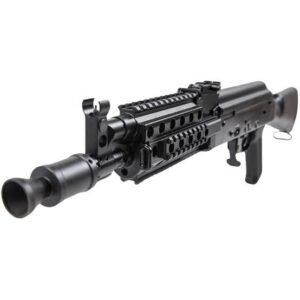
As a result, the rifle continues operating even in adverse environments.
The magazine system of AK-pattern rifles also contributes to reliability. Most AK magazines are constructed from durable materials such as steel or reinforced polymers. The curved shape of the magazine accommodates the natural taper of certain intermediate cartridges wbp rogów mini jack rifle.
Consequently, cartridges feed smoothly into the chamber.
Additionally, the magazine locking system uses a front lug and rear catch design, which secures the magazine firmly inside the receiver. When the magazine is inserted, the front lug engages a slot in the receiver, and the rear latch locks the magazine into place.
This locking method creates a stable feeding platform for the cartridges.
Another mechanical characteristic of AK-pattern rifles is the large charging handle integrated into the bolt carrier. This handle allows the user to manually cycle the action when necessary. Because the charging handle connects directly to the bolt carrier, it provides strong mechanical leverage.
Consequently, the user can clear the chamber or chamber a round reliably.
AK-pattern rifles also incorporate a simple safety and selector mechanism located on the side of the receiver. This lever serves two purposes: it prevents the trigger from being pulled when engaged, and it can select different firing modes in certain configurations wbp rogów mini jack rifle.
When the safety lever is in the upward position, the trigger mechanism remains blocked. As a result, the rifle cannot fire accidentally wbp rogów mini jack rifle.
The design philosophy behind these mechanical systems reflects a focus on simplicity and durability. Engineers deliberately avoided unnecessary complexity in order to reduce the likelihood of mechanical failure. Fewer moving parts generally mean fewer components that can break or malfunction wbp rogów mini jack rifle.
Consequently, AK-pattern rifles have earned a reputation for reliable operation wbp rogów mini jack rifle.
Furthermore, the operating system is relatively easy to maintain. Most AK-pattern rifles can be disassembled into major components without specialized tools. During field maintenance, users typically remove the receiver cover, recoil spring assembly, bolt carrier, and gas tube.
This simple disassembly process allows internal components to be cleaned and inspected quickly.
The engineering tradition behind the AK platform traces back to the work of Mikhail Kalashnikov, whose design principles emphasized reliability above all else. Although many later engineers and manufacturers have refined the platform, the core mechanical system remains largely unchanged wbp rogów mini jack rifle.
Consequently, modern AK-pattern rifles continue to operate using the same basic principles developed decades agowbp rogów mini jack rifle .
Today, the mechanical design of AK-pattern rifles is often studied in engineering and military history discussions. The system demonstrates how a relatively simple mechanical arrangement can achieve long-term reliability and widespread adoption wbp rogów mini jack rifle.
Because of this enduring design philosophy, the AK operating system remains one of the most influential rifle mechanisms ever developed wbp rogów mini jack rifle.
Global Production, Variants, and Industrial Adaptation of AK-Pattern Rifles WBP Rogów Mini Jack Rifle Tactical
After the original Kalashnikov rifle design was introduced and adopted for military use, its influence expanded rapidly across multiple regionswbp rogów mini jack rifle . Over time, AK-pattern rifles were manufactured by numerous countries, each adapting the design to its own industrial capabilities and military requirements. Because the underlying mechanism remained relatively simple and durable, the rifle platform proved adaptable to different manufacturing environments. Consequently, the AK system evolved into a broad family of rifles produced around the world wbp rogów mini jack rifle.
During the early years of production, rifles based on the Kalashnikov design were manufactured primarily within the Soviet Union. However, as political alliances and defense agreements developed during the Cold War period, the design began to spread to other nations. Some countries received official licenses to produce rifles locally, while others developed their own manufacturing processes based on the original design wbp rogów mini jack rifle.
As a result, AK-pattern rifles became one of the most widely produced rifle platforms in modern history wbp rogów mini jack rifle.
The first widely produced version of the design was known as the AK-47, which introduced the basic configuration that many later variants would follow. This early model featured a gas-operated rotating bolt system, a detachable curved magazine, and wooden furniture components such as the stock and handguards wbp rogów mini jack rifle.
Although this configuration proved reliable, engineers later introduced refinements that improved manufacturing efficiency and weight reduction wbp rogów mini jack rifle.
One of the most significant updates occurred with the development of the AKM, an improved version of the original design. Engineers modified several components of the rifle to simplify production and reduce weight. For example, stamped steel receivers replaced earlier milled receivers in many models.
Stamped receivers could be produced more quickly and with fewer machining operations.
Consequently, large numbers of rifles could be manufactured efficiently.
The AKM also introduced changes to the rifle’s internal components and furniture materials. Many rifles produced during this period used laminated wood stocks, which provided greater resistance to environmental conditions compared with solid wood. Laminated materials also helped reduce warping caused by humidity or temperature changes.
As a result, rifles remained structurally stable in a variety of climates.
Another development involved the introduction of different barrel lengths and configurations designed for specialized roles. Some rifles were produced with shorter barrels to create compact carbines suitable for vehicle crews or close-quarters environments. Others maintained longer barrels for general infantry use.
Because the core operating system remained unchanged, these variations could be implemented without major mechanical redesign.
In addition to manufacturing changes, engineers also experimented with new materials and ergonomic improvements. For example, polymer components gradually replaced wooden parts in some versions. Polymer stocks, pistol grips, and handguards offered several advantages: they reduced weight, resisted moisture, and simplified production.
Consequently, many modern AK-pattern rifles incorporate synthetic materials.
The widespread adoption of the AK design also led to the creation of numerous regional variations. Different countries introduced their own modifications to suit local manufacturing methods and military preferences. Some variants incorporated unique stock shapes or sight systems, while others adjusted internal components to match available production technology wbp rogów mini jack rifle.
Despite these differences, most AK-pattern rifles retained the same fundamental operating mechanism.
Another factor contributing to the platform’s global presence was its adaptability to different industrial capabilities. Because the design emphasized mechanical simplicity, factories with varying levels of technical infrastructure could produce rifles successfully. Complex machining processes were not always required, especially when stamped receiver designs were used wbp rogów mini jack rifle.
Consequently, the rifle platform could be manufactured in both advanced industrial facilities and smaller production environments wbp rogów mini jack rifle.
The influence of the AK platform extended beyond military applications as well. In many regions, civilian sporting and recreational versions of the design were developed. These rifles typically retained the external appearance and mechanical principles of the original system while complying with local regulations governing civilian firearms.
As a result, the platform became familiar to civilian shooting communities around the world.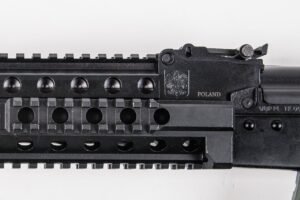
The design philosophy originally associated with Mikhail Kalashnikov remained evident throughout these global adaptations. Kalashnikov’s design focused on durability, ease of maintenance, and reliability under challenging conditions. These priorities continued to influence later manufacturers who produced rifles based on the platform.
Consequently, the AK system maintained a reputation for mechanical resilience wbp rogów mini jack rifle.
In addition, the AK platform inspired ongoing experimentation with accessories and modular components. Modern variants often include mounting rails that allow optical sights or other equipment to be attached. Although early versions relied primarily on iron sights, contemporary adaptations accommodate a wider range of sighting systems wbp rogów mini jack rifle.
This flexibility demonstrates how the design has evolved while preserving its core mechanical principles.
Furthermore, the AK platform continues to serve as a case study in industrial design and engineering efficiency. Historians and mechanical engineers frequently examine the system as an example of how straightforward mechanical solutions can achieve widespread adoption wbp rogów mini jack rifle.
The combination of simple construction, reliable operation, and adaptable manufacturing methods helped ensure the platform’s long-term relevance wbp rogów mini jack rifle.
Today, AK-pattern rifles remain an important subject within discussions of twentieth-century engineering history. Their global production history illustrates how a single design can evolve through decades of manufacturing innovation and regional adaptation wbp rogów mini jack rifle.
Because of this extensive history, the AK platform remains one of the most recognizable and widely studied rifle systems ever developed wbp rogów mini jack rifle.
Reviews
There are no reviews yet.